I have always wanted to enter Retro Challenge, ever since I first heard of it nearly 24 hours ago. I followed a link that took me to http://retrochallenge.net/ and I read up on what it was all about, scrutinised the rules and checked out what others were doing. I quickly came to the conclusion that I could give this a thing a go. All I needed to do* was come up with a suitable challenge for myself.
I have decided to make my name appear in LED lights.
So an email was sent to the competition organisers;
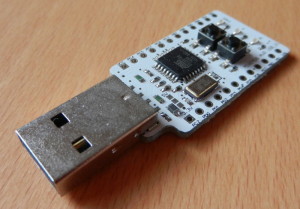
A little while back, Nottingham Hackspace got the opportunity to buy a bunch of Minimus V1 AVRs at a very good price. Not being one to turn down a bargain, I bought a few of these little critters to see what they can do. On paper, they look great. USB programmable micro running an Atmel chip similar to an Arduino (so possibly compatible with the Arduino IDE), in a package slightly bigger than your average USB stick but with a couple of buttons, LEDs and all the pins broken out.It turns out that there's a lot of misleading, conflicting, partial, out of date, or hard to follow info out there, not to mention that most of it is for the Minimus V2. I had the V1, so struggled to get it to do anything exiting at all for ages. After a very frustrating day of trying stuff, following dead links and generally wasting a lot of time, I got some joy with the Arduino IDE. To save you the hassle, read on for what worked for me.
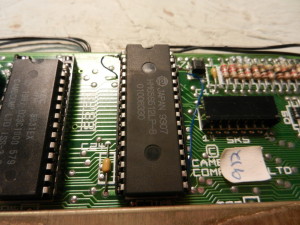
As mentioned in a couple of other posts here, the Z88 is a great machine. It comes with 32k of RAM, although this can be expanded with plug in cartridges. An alternative, however, is to replace the internal 32k with something larger. This photo tutorial shows how you can expand the onboard memory to 512k. This involves some pretty hardcore soldering, and is not recommended for your first soldering project. More importantly, there is some delicate unsoldering too, and if things go wrong, you've wrecked your Z88. You have been warned!
If you've been reading this blog in cronological order, you'll know about the FTDI adapter I made for the Z88. If you don't read this in order, you'll know about the Minimus programming I've been doing and what the Minimus is (note that I've not blogged about that yet... be patient!) Now to turn it in to something genuinely useful...
I have already blogged on here about how awesome the Z88 is, and how ahead of it's day it was. Well, being awesome in your own right doesn't cut it these days - so you've got to be able to communicate and talk to things to be considered worthwhile. The biggest weapon the Z88 has up its sleeve is the humble serial port. Combined with the built in terminal software (as well as the ability to 'print' serial data) and you've got a beast that's almost ready to talk to anything. Almost... But first there's the slight problem of the non-standard pinout of the serial port, and then there's the issue that few things these days use +\-6v to communicate
I have seen the future of computers. Yes, really I have. What would you say if I said the future would be something about the size of a pad of paper. Which runs off of 4 AA batteries, giving it about 20 hours of use or 100 days of standby. Storage is solid state with no delicate moving parts, and can be expanded with plug in modules. Software and files can be stored on these modules or bought with pre-installed on. Built in apps include word processor, spreadsheet, database, diary, communications manager, alarm clock etc. Full size tactile physical QWERTY keyboard.

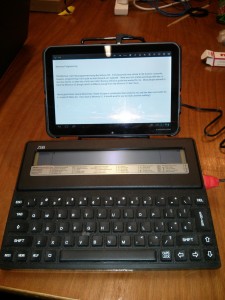 Now to turn it in to something genuinely useful...
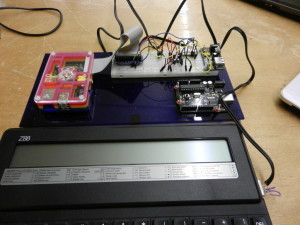 But first there's the slight problem of the non-standard pinout of the serial port, and then there's the issue that few things these days use +\-6v to communicate