When I ordered my £25 Raspberry Pi, I didn't know what I was going to do with it, but when I heard that XBMC had been ported to run on the Pi I realized that I needed 2 Pis; one for XBMC, and the other so I could have one I didn't know what to do with!
As regular followers of the blog will know, I love Arduinos and all the stuff they can do. Those that know me will also know that I don't love Christmas, particularly the seasonal decoration stuff. So this project was a nice mix of the two! I decided to make myself some Arduino powered Xmas lights that vary their 'chase' speed based upon how close people are to my house. Intrigued? Read on...
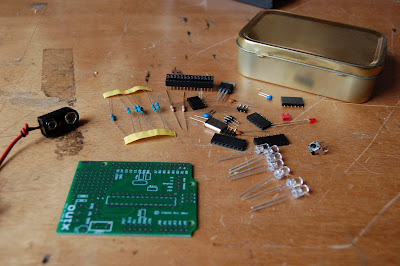
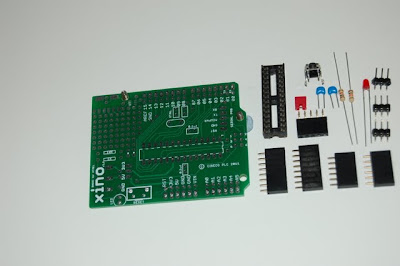
This week I... Built a Xino Basic for Atmel as sold on http://shop.ciseco.co.ukThis is sold as a kit that anyone with even the most basic of soldering skills can put together. This is just about the cheapest way to get an Arduino compatible board that fits the standard Arduino shields. It also boasts a nice little prototyping area at the top which will mean that a lot of smaller projects can be completed without the need for additional shields. (See my Xino Dice post for an example of how the prototyping area can be used)The main kit comprises of the PCB, processor socket, connector headers and some resistors, capacitors and an LED
A couple of days ago I got a Xino board like this one. Not is this about the cheapest way to get an Ardunio compatible microprocessor, but it has the benefit of a nice little prototype area on board too. So, although it fits standard Arduino shields, many simple projects can be completed on just the one board. I wanted to do something simple and nice with it, and with components and hardware I had to hand. I realised the prototype area would be great for mounting LEDs, and so the idea of a digital dice was born. I gathered a few bits and bobs and got the soldering iron out.


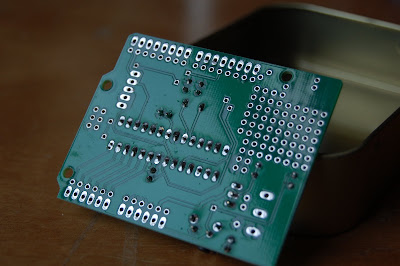 I wanted to do something simple and nice with it, and with components and hardware I had to hand. I realised the prototype area would be great for mounting LEDs, and so the idea of a digital dice was born. I gathered a few bits and bobs and got the soldering iron out.