
ATtiny (4)
Minimus 1.0 AVR Programming
A little while back, Nottingham Hackspace got the opportunity to buy a bunch of Minimus V1 AVRs at a very good price. Not being one to turn down a bargain, I bought a few of these little critters to see what they can do.
On paper, they look great. USB programmable micro running an Atmel chip similar to an Arduino (so possibly compatible with the Arduino IDE), in a package slightly bigger than your average USB stick but with a couple of buttons, LEDs and all the pins broken out.
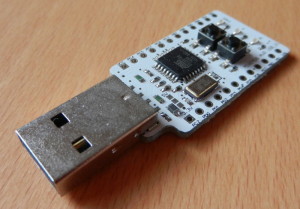
It turns out that there's a lot of misleading, conflicting, partial, out of date, or hard to follow info out there, not to mention that most of it is for the Minimus V2. I had the V1, so struggled to get it to do anything exiting at all for ages. After a very frustrating day of trying stuff, following dead links and generally wasting a lot of time, I got some joy with the Arduino IDE. To save you the hassle, read on for what worked for me.
3 Stage ATtiny85 Watchdog Timer
A while ago I started logging temperatures to Pachube via a Nanode. For the most part this works fine, but sometimes something breaks and I might lose a few hours or days worth of data. It might be the Nanode that's gone down, or Pachube, or (most likely) my Internet connection. So I decided to build a simple 3 stage external Watchdog Timer that would monitor the status of the feed and start taking steps to rectify it.
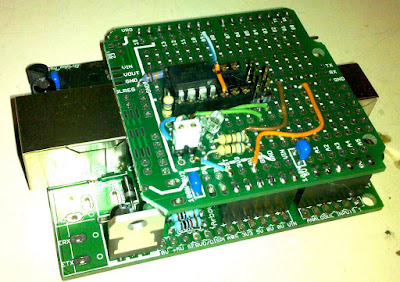
Building an ATtiny ISP from a Xino
If you have seen my previous blog entry, you'll know I have been playing around with an ATtiny85 for an upcoming project (more on that later...). Using an Arduino (or, in my case a Xino from Ciseco) is easy enough, but when a sketch needs lots of tweaking to fine tune it, it means the ATtiny spends most of its time going in and out of the breadboard. So I decided to build a dedicated ATtiny programmer
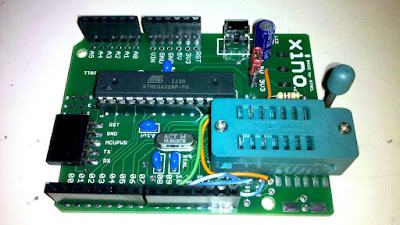
ATtiny Micro Programming With Arduino IDE
One of the most appealing things about the Arduino and ATmega328 is their size and simplicity. After working with desktop and server computers for years I just loved how a small little chip could be programmed easily to achieve things that I cannot get a full blown computer to do. I have never been a computer programmer though, but I know they don't interface with the 'real' world too easily.
If a 28 pin micro controller is good, wouldn't an 8 pin micro be even better? Well, I started to research the ATtiny85 and discovered that it is almost as good as its big brother in some situations. But best of all, it can be programmed from the familiar Arduino IDE

