
Recent Articles
-
Xino Basic Build
This week I... Built a Xino Basic for Atmel as sold on http://shop.ciseco.co.uk This is sold as a kit that anyone with even the most basic of soldering skills can put together. This is just about the cheapest way to get an Arduino compatible board that fits the standard Arduino shields. It also boasts a nice little prototyping area at the top which will mean that a lot of smaller projects can be completed without the need for additional shields. (See my Xino Dice post for an example of how the prototyping area can be used)The main kit comprises of the PCB, processor socket, connector headers and some resistors, capacitors and an LED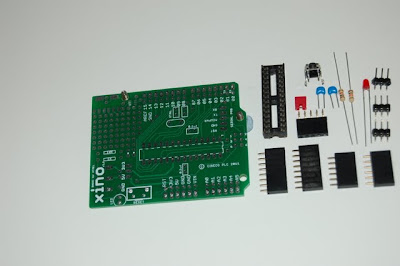
-
An aDventure in to aProtocol (or LLAP)
I've been messing about with Arduino derived micro controllers, and have been looking for a way to get them to send simple messages to and from each other. Something simpler than TCP/IP (which requires special hardware and relatively large libraries to run it), but more generic and flexible than just connecting an output pin on one device to the input pin on another. aProtocol (or LLAP as it's also known) as defined on OpenKontrol seems to fill that gap just nicely. So, in 16 lines of code, I got a simple acknowledgement working;String msg; String reply; void setup() { Serial.begin(9600); Serial.print("aDDSTARTED--"); } void loop(){ if (Serial.available() >= 12){ if (Serial.read() == 'a') { if (Serial.read() == 'D' && Serial.read() == 'D'){ msg = ""; for (byte i=0; i<9; i++) msg += Serial.read(); if (msg.compareTo("HELLO----")) reply = "aDDHELLO----"; // else if ... Serial.print(reply); } } } } -
Xino Dice
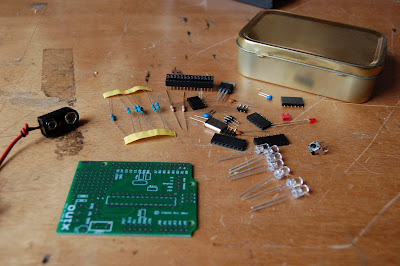
A couple of days ago I got a Xino board like this one. Not is this about the cheapest way to get an Ardunio compatible microprocessor, but it has the benefit of a nice little prototype area on board too. So, although it fits standard Arduino shields, many simple projects can be completed on just the one board.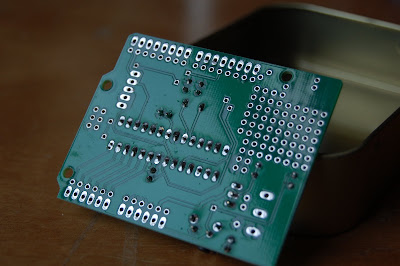 I wanted to do something simple and nice with it, and with components and hardware I had to hand. I realised the prototype area would be great for mounting LEDs, and so the idea of a digital dice was born. I gathered a few bits and bobs and got the soldering iron out.
-
£1 Logic Probe
A decent multimeter is great, but there's times when you just want to have a quick check to see what signals are high, low or neither. A logic probe is ideal for this, but the cheap ones are about £15+, so I decided to build my own. For less than a quid!
-
30 Second Nanode Build
A couple of months ago I bought a Nanode, which required self assembly. Whilst I was building it, I thought it would have been nice…
-
First 77 Days of Arduino Enlightenment In Photos
Less than 3 months ago I didn't even know what an Arduino was. A couple of times I had stumbled upon them with various web…